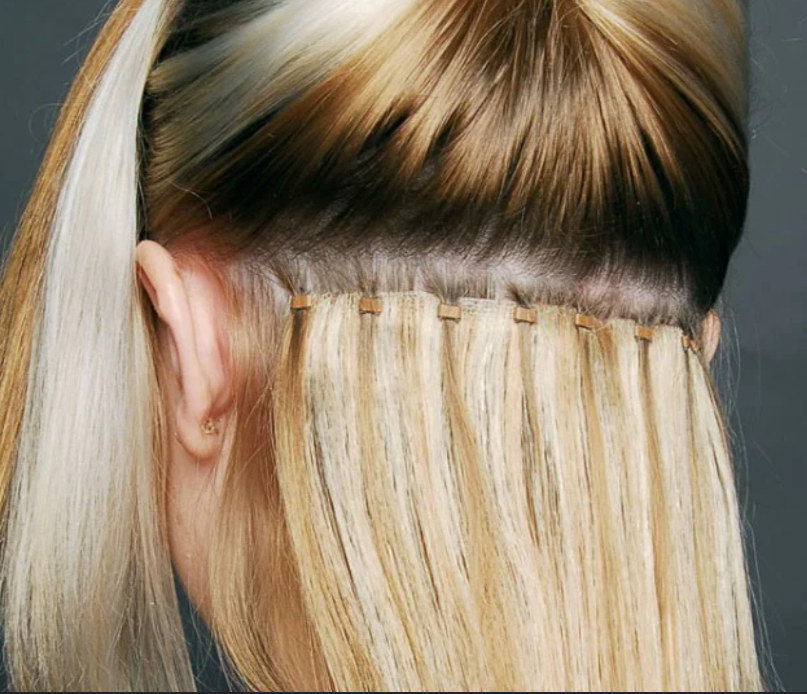
A sew-in uses a braided track: your stylist braids a thin row of your own hair close to the scalp, then sews wefts of extension hair onto that braid with thread. There is no glue, tape or heat involved. Sew-ins are secure, can add a lot of hair in a single row, and tend to work best on thick, healthy hair that can hide the braid. Here is what the method involves, who it fits and how to take care of your scalp while you wear it.
How a braided track sew-in works
The method has two parts.
The track. A horizontal part is made across the back of the head, and the hair along that line is braided tightly and flat against the scalp. That braid becomes the anchor.
The weft. A weft is a long strip of extension hair stitched together at the top. Your stylist lays the weft along the braid and sews it on with a curved needle and thread, looping through the braid every short distance.
Depending on how much fullness and length you want, one row or several rows may be placed. Your own hair falls over each row and covers it.
Comparing methods? The K-tip vs. tape-in vs. sew-in comparison shows all three together. This guide focuses only on sew-ins.
Who sew-ins suit
Density matters more than anything with a sew-in. The braid adds a little bulk, and the weft adds weight along a single line. Thick hair hides both. Fine hair can show the braid and may feel strain along the track.
Good fit:
- Thick or dense hair, including coarse or wavy textures
- People who want to avoid adhesive or heat bonds
- Anyone who wants a lot of added fullness in fewer attachments
- People who mostly wear their hair down or in low styles
Think twice if:
- Your hair is fine, thin or fragile at the nape
- You wear high ponytails or tight updos often, since the rows can show
- You have scalp sensitivity or tend to get tension headaches with tight styles
- You can't commit to keeping the braid clean and dry
If you're not sure how dense your hair actually is, why your hair might be hard to manage explains the difference between density and strand thickness. They're easy to confuse.
What happens at the install
The Sew In Extensions service is $200 plus the cost of the hair on the current menu, and it's listed at about 3 hours. Extension services are request-to-book, and the hair is purchased separately and color-matched to you at your consultation. See the Sew In Extensions service page.
A typical appointment:
- Clean, dry hair. Arrive with hair washed and fully dry, or plan for a wash at the start.
- Mapping the rows. Your stylist plans where each track goes so it sits under enough hair to stay hidden.
- Braiding. Each track is braided snug and flat. Tight enough to hold, not so tight it pulls at the scalp.
- Sewing. Wefts are measured, laid along the braid and stitched in place.
- Cut and blend. The weft hair is cut into your own so the length and layers look natural.
- Style and care lesson. You'll leave styled with a routine for washing and drying.
The first few days
Expect your head to feel snug along the braids for a day or two. That's the braid settling. Sleep on a silk or satin pillowcase, keep your hair in a loose low braid at night, and skip tight hats or headbands right away.
Call your stylist if you notice:
- Sharp or ongoing pain along a braid
- Small red bumps along the track
- Headaches that don't ease after the first couple of days
Those can be signs the braid is too tight, and it's much easier to fix early.
Scalp care with a sew-in
The braid and the area around it need regular attention, because sweat, oil and product can collect along the track.
| Step | How |
|---|---|
| Cleanse along the braid | Dilute shampoo with water in an applicator bottle and apply along each row, then massage gently with your fingertips |
| Rinse well | Let water run along the part lines so no shampoo is left in the braid |
| Condition the lengths only | Keep conditioner from mid-length down, away from the braid |
| Dry completely | Use a blow dryer on low or medium heat along each row until it's fully dry |
| Keep it light | Skip heavy oils and greases on the braid, which can build up |
A braid that stays damp can smell musty and irritate your scalp. Drying fully is the most important habit you can build. For the full washing routine, see how to wash hair with extensions.
Kansas City summers make this more important. Heat and humidity mean more sweat at the scalp, so plan on washing and drying the braid more often in July and August than in January.
Move-ups: re-braiding and re-sewing
As your hair grows, the braid moves down from the scalp and the track gets loose. The weft starts to hang lower and can shift or tangle. At that point you need a move-up.
At a sew-in move-up:
- The thread is cut and the wefts are carefully removed.
- The old braid is taken out and your hair is detangled, washed and checked.
- A fresh braid is made back up near the scalp.
- The wefts (if they're still in good shape) are sewn back on.
The Move Up service starts at $100 on the current menu and is listed at about 4 hours, varying by method. See the Move Up service page. Your stylist will set your timing based on how fast your hair grows and how the track is holding. For signs you're due, read extension move-ups and removal explained.
Why you shouldn't take it out yourself
It can look simple: cut the thread, pull out the weft. The risk is in the braid. Hair that has been braided for weeks holds shed hair and tangles, and cutting near the braid makes it easy to snip your own hair. A stylist removes the thread without cutting your hair, unbraids gently and detangles from the ends up.
Get started with Hoshika in Overland Park
I install sew-ins one-on-one in my private studio inside Willow Salon & Suites on 135th Street, close to Leawood, Olathe and south Kansas City. At your free consultation I'll check your density and scalp, talk about how you wear your hair, and color-match your wefts so they disappear under your own hair. Book your free consultation and we'll plan your rows.
Frequently asked questions
Do sew-in extensions use glue or heat?
No. A braided track sew-in uses only your braided hair, thread and a needle, which is why people who want to avoid adhesive or heat bonds often choose it.
Are sew-ins good for fine hair?
Usually not. The braid needs enough hair around it to stay hidden and to share the weight, so sew-ins tend to suit thick or dense hair best.
Why does my scalp feel tight after a sew-in?
The braid sits close to the scalp, so mild snugness for the first day or two is common. Pain, ongoing soreness or bumps along the braid are not normal and should be checked by your stylist.
Can I wash my hair normally with a sew-in?
You can wash it, but focus on cleaning along the braid gently and drying it completely. A damp braid can lead to odor and irritation.
Book with Hoshika
Want this done for you?
Private one-on-one studio in Overland Park. Free consultations for big changes.